# Vulnerability Scanning on Private Packages - Maven
When letting Aikido scan your dependencies in repositories with private maven packages, Aikido would need to also have access to the private packages. You can now provide private Maven settings.xml configuration in Aikido for this.
## Prerequisites
**Prepare settings.xml**
For private Maven packages, Aikido uses a settings.xml file to authenticate with the private registry.
Example settings.xml for accessing private packages on a private registry:
```xml
your-repository-idyour-usernameACCESS_TOKENprivate-registryyour-repository-idhttps://...
```
{% hint style="warning" %}
Include the `` section with your repository URL. Scanning only needs the `` credentials, but the credential test in Aikido runs without your `pom.xml` and needs the URL to test the connection. Use the same `` in ``, in the profile, and in your `pom.xml`.
{% endhint %}
**Make sure your pom.xml files have** `releases` **or** `snapshots` **enabled**
```xml
your-repository-idhttps://...truetrue
```
## Configuration in Aikido
Once the prerequisites are fulfilled, you can configure Aikido to authenticate with your private Maven registry when updating the dependencies by following the steps below:
1. Go to [**AutoFix** → **Settings**](https://app.aikido.dev/issues/fix/settings) in the Aikido app and click **Connect Registry** in the **Private Registry Connection** section.
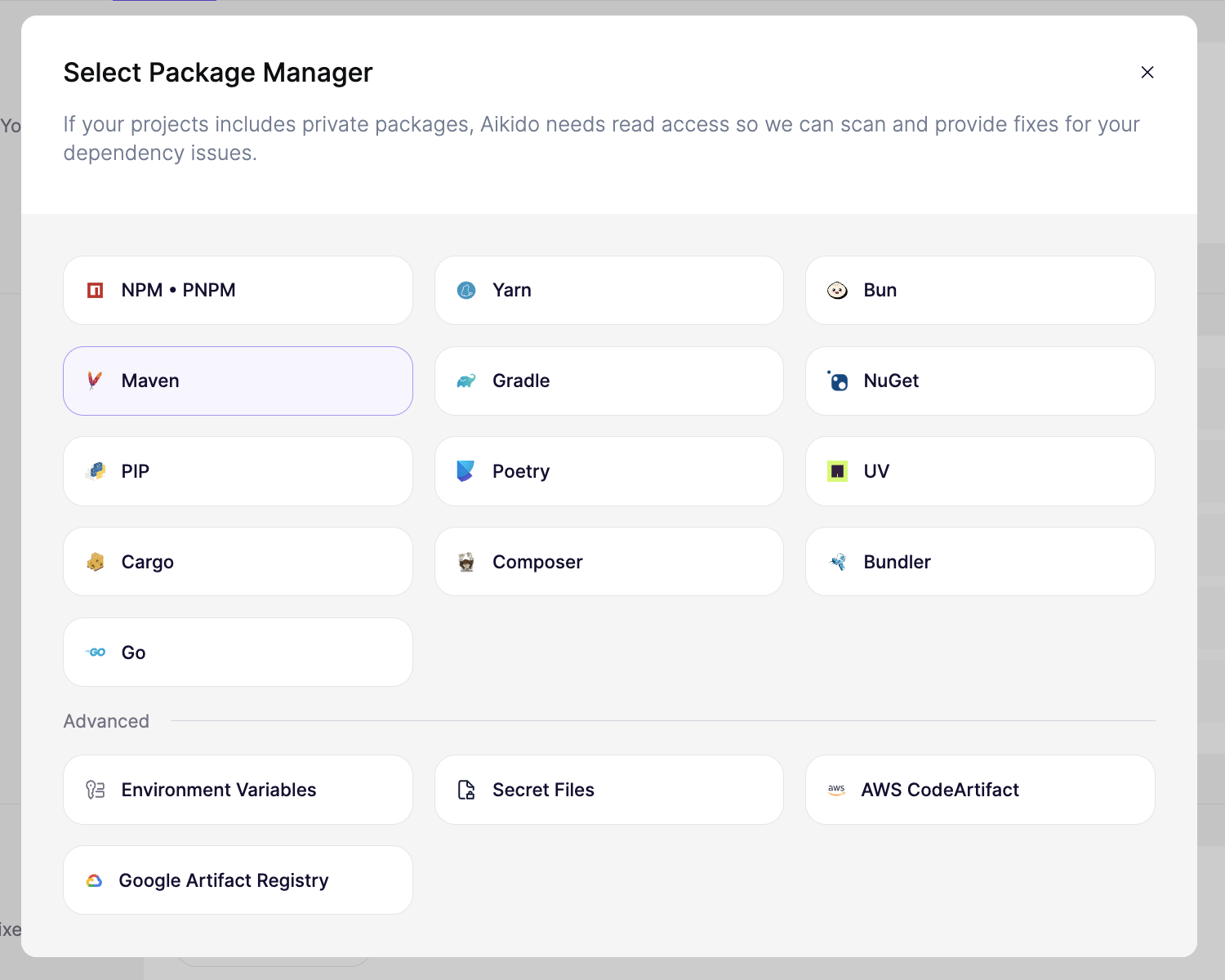
2. Select **Maven**.
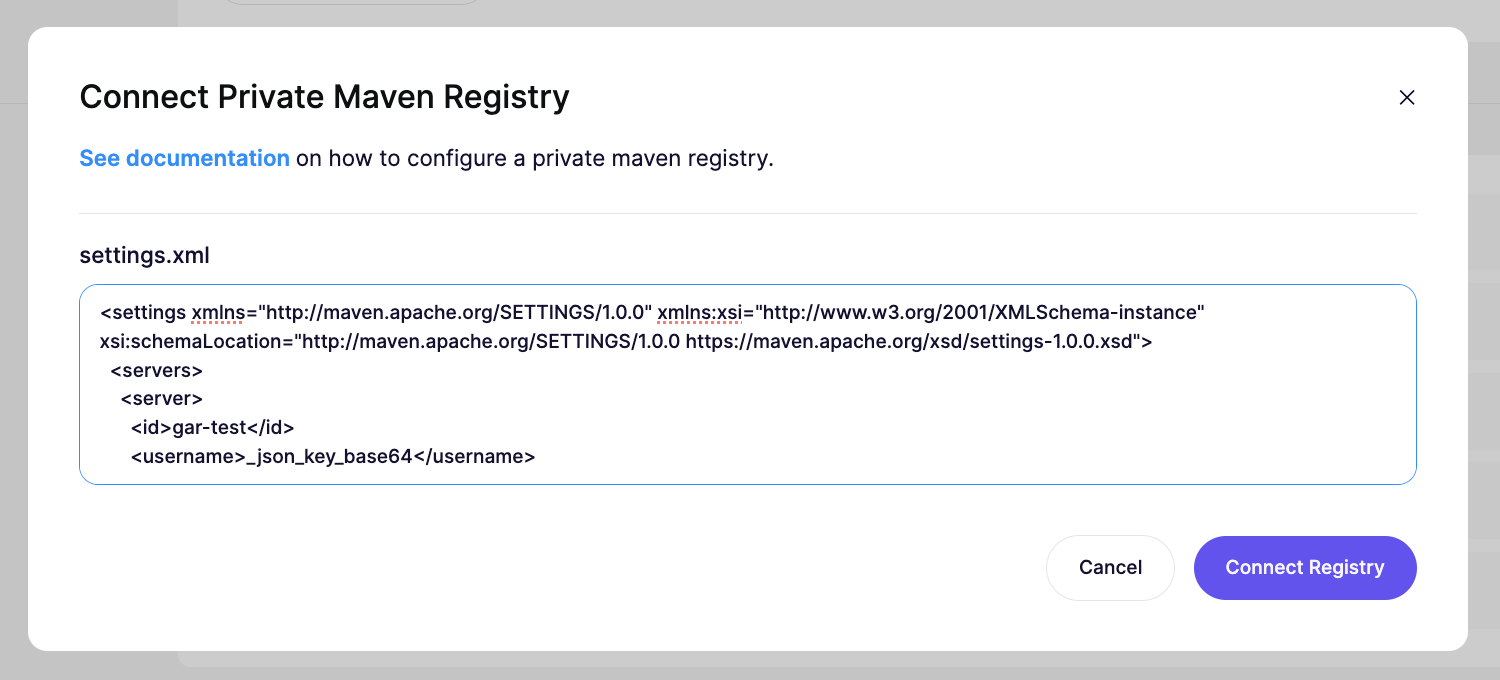
3. Paste your settings.xml contents and click **Connect Registry**.
4. Aikido tests the credentials and shows the result next to the Maven connection.
5. In the next scans, this settings.xml will be used by Aikido.
## AWS CodeArtifact
To set up the AWS CodeArtifact connection, see [AWS CodeArtifact - Private Packages](https://help.aikidogov.us/autofix-and-remediation/connect-private-packages/aws-codeartifact-private-packages).
## GitHub Packages
The Maven registry on GitHub Packages requires a classic personal access token with the `read:packages` scope. Fine-grained personal access tokens are not supported for this registry.