
ClickUp
This one-time setup per workspace allows everyone in your Aikido organization to create issues directly in ClickUp.
Following use cases are supported :
- Automated Ticket Creation: Automatically create and push tickets to specified ClickUp projects for seamless tracking of security issues.
- Manual Ticket Addition: Manually add security issue tickets to ClickUp, ensuring targeted attention for critical vulnerabilities.
Connecting the Aikido App to ClickUp
-
Navigate to Integration Settings within the Aikido app.
-
In the 'Task Trackers' section, select 'ClickUp'
-
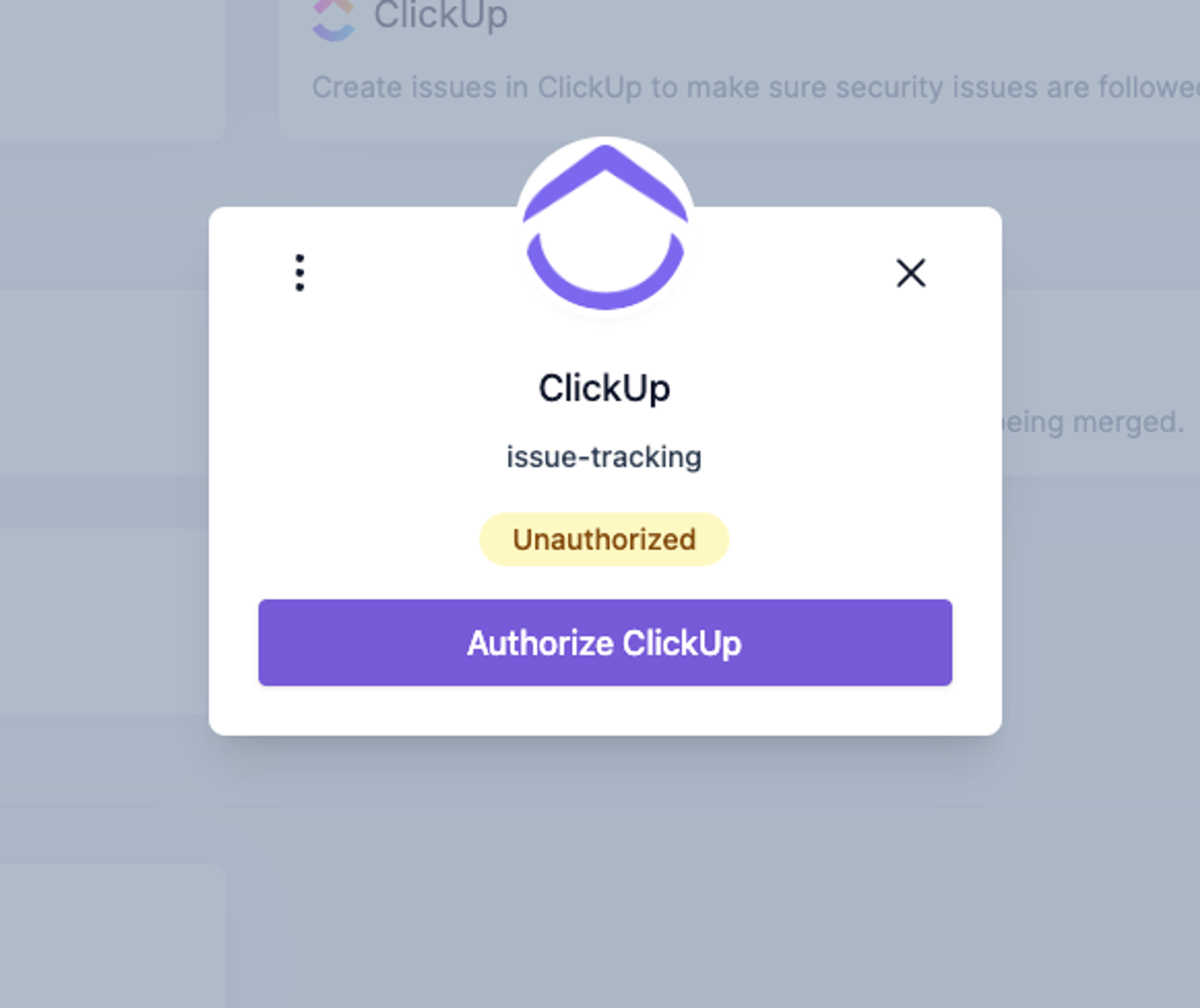
A prompt will request authorization for ClickUp.
-
Login into your ClickUp account
-
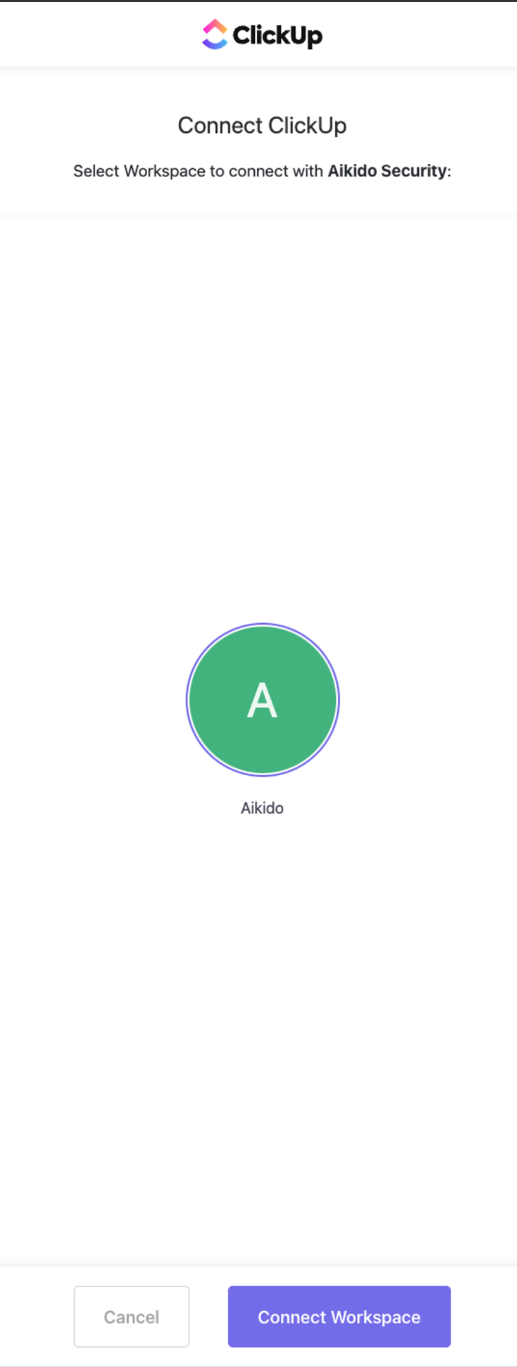
Grant Aikido permission to access your ClickUp workspace
-
Once authorized, Aikido is successfully connected to ClickUp, enhancing your task management capabilities 🚀
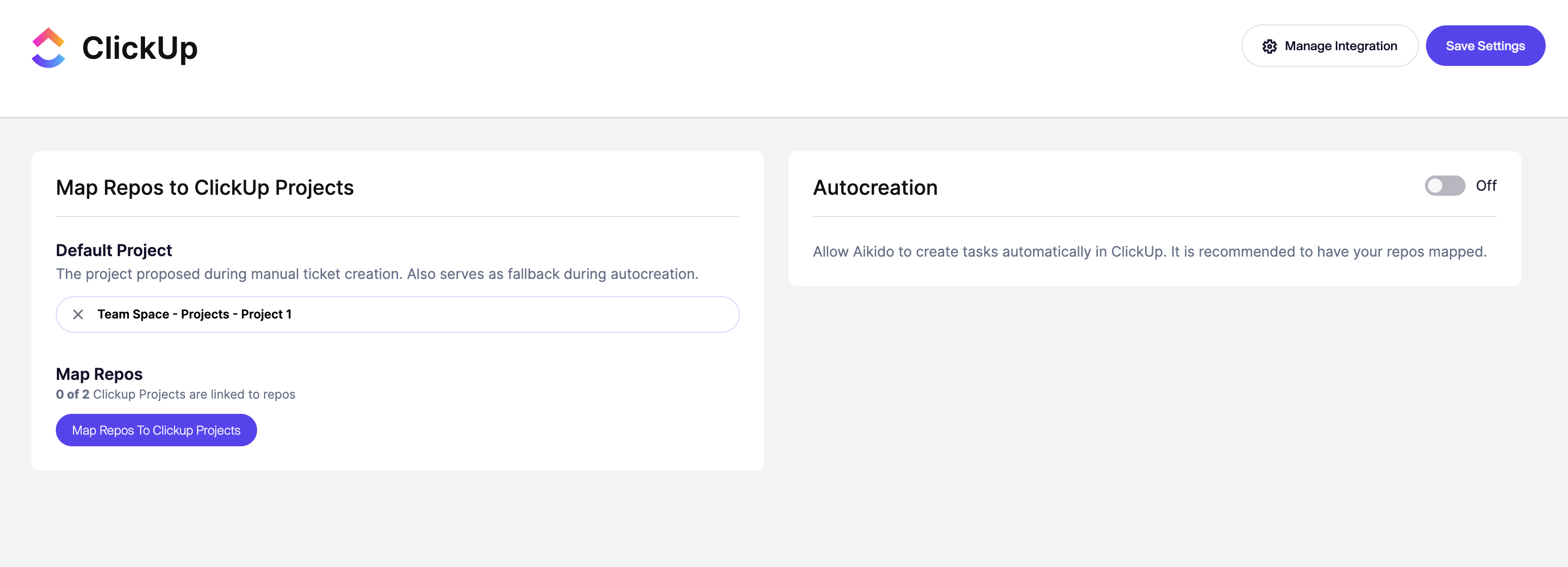
Options for Task Creation in ClickUp via Aikido
There are two different options to create new tasks from Aikido into ClickUp.
- Manually create tasks from the Aikido interface
- Automatically create new tasks via Aikido's auto creation functionality.
1. Manual Task Creation
-
Hover over any issue in your feed and click the + in the assignee column.
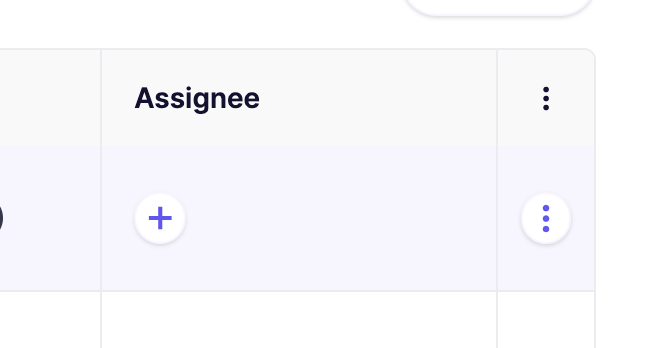
Alternatively, you can click the triple dots in the last columns to open up the action menu. If you have grouped issues, the triple dot action menu is available on every subissue.
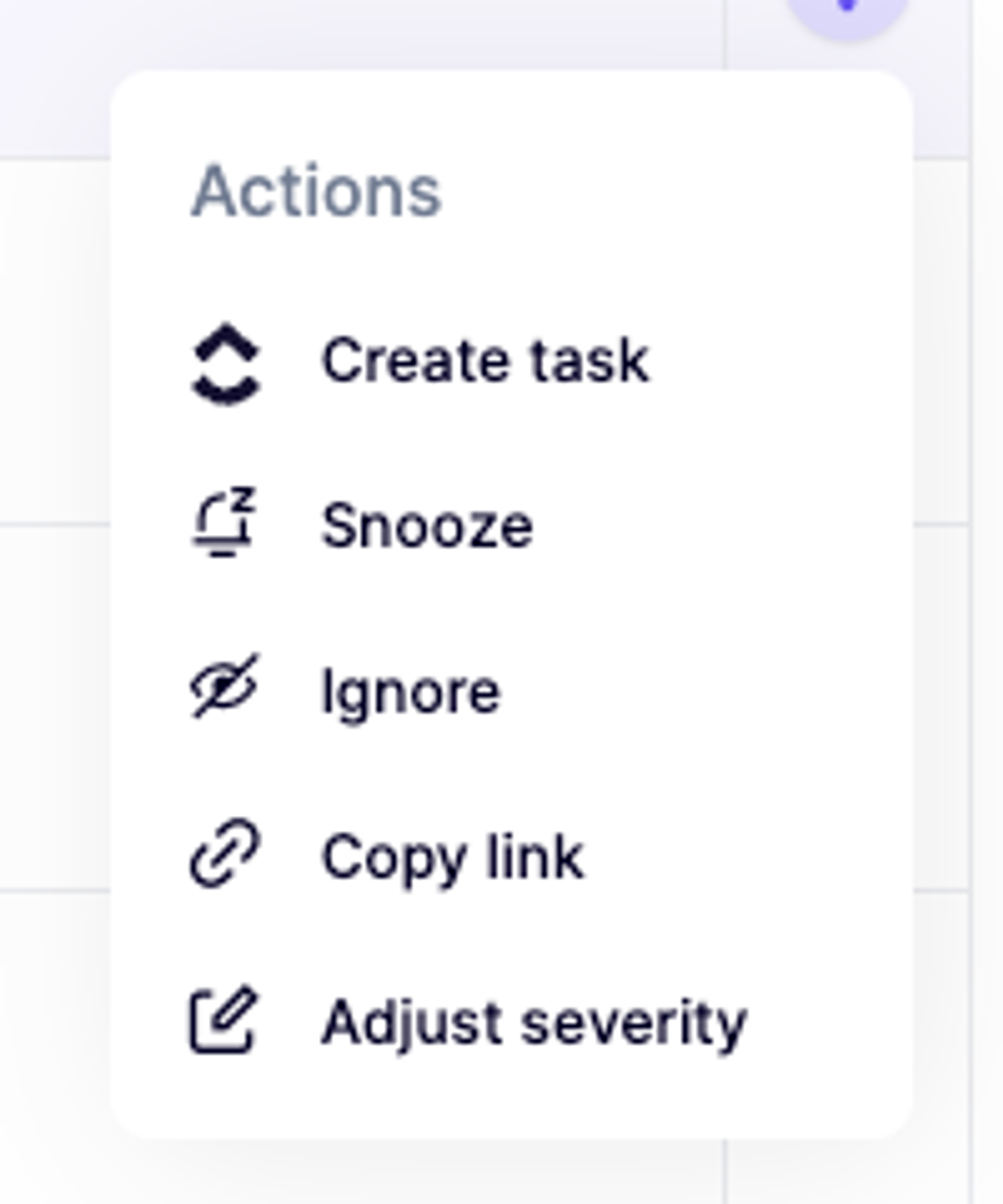
-
Fill in the required details in the popup modal.
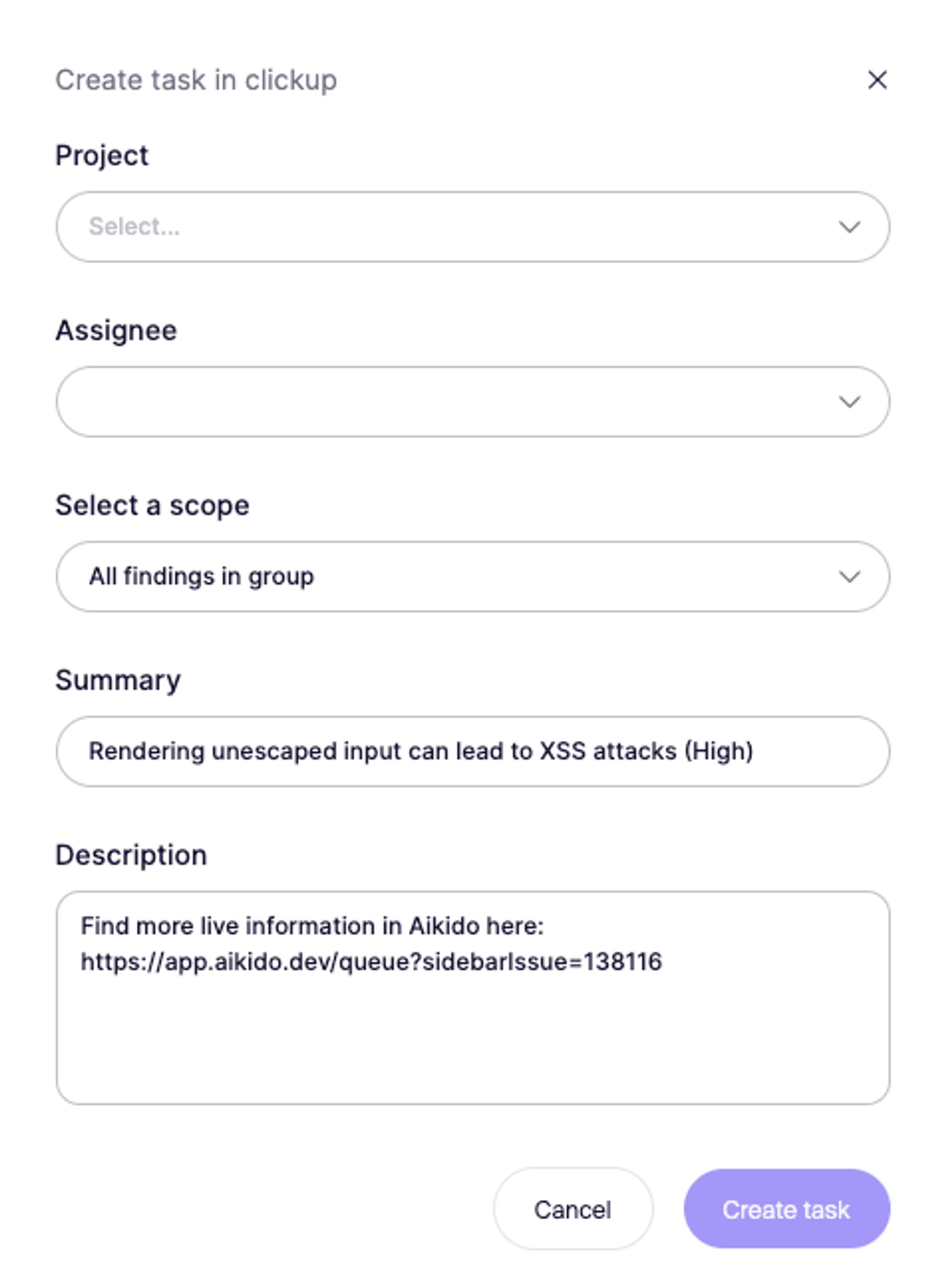
-
The newly created task in ClickUp will be linked in the Aikido Issue Detail under the 'Tasks' tab (sidepanel).

2. Automated Task Creation
Aikido will automatically create tasks every hour in bulk. There is at the moment no option to trigger this manually.
- Go to the ClickUp Integration settings
- Make sure to enable 'Autocreation' by clicking the toggle to On.
- Define the criteria for automatic task creation.
You can configure all of these settings in the autocreation modal:
- On/Off: Enable or disable autocreation. When off, the threshold is effectively set to
None. - Severity threshold: Create tickets for issues at
Critical,High,Medium, orLowand above. For example,Highcreates tickets forHighandCritical. - Issue types: Create tickets for all issue types, or limit them to specific types like
SCA,SAST,Secrets,Cloud,IaC,Malware, orLicense. - Daily limit: Set the maximum number of tickets created per day. The default is
25. Some plans support higher limits. - Ticket creation mode: Create one ticket per issue group, or create separate tickets per location or scope. Per-location mode can create more tickets.
- Scope: Available only in per-location mode. Target all repos or clouds, only mapped repos or teams, or specific repos or clouds with include and exclude lists.
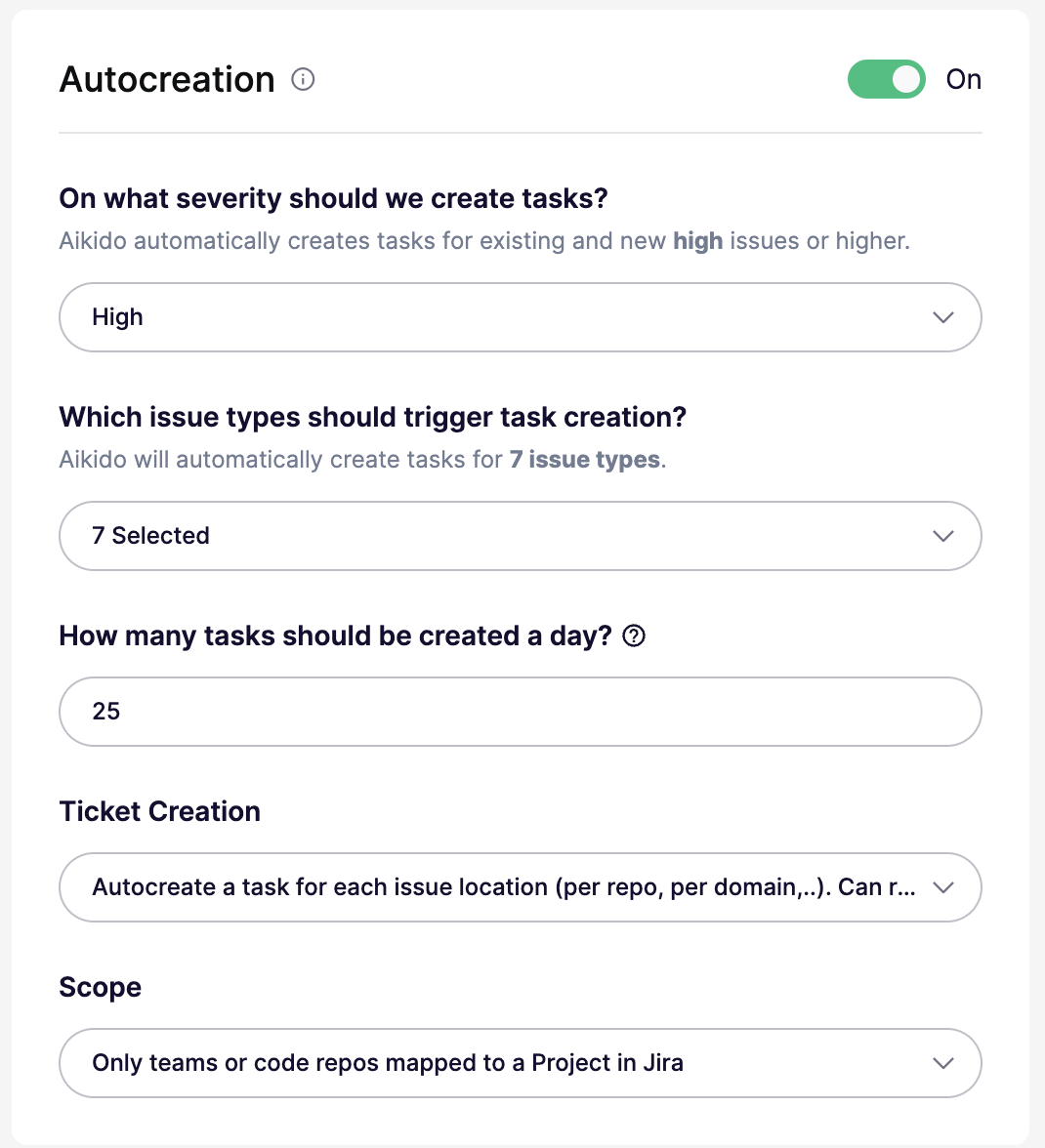
- Aikido will then autonomously generate ClickUp tickets based on these settings 🚀
Map Aikido data to custom fields
Aikido can fill ClickUp custom fields on every task it creates. Use it to send severity, SLA dates, links, and other Aikido data straight into your ClickUp fields.
Supported field types
| ClickUp field type | Example value |
|---|---|
| Text | Severity: $SEVERITY |
| Text area (long text) | $TLDR |
| Website | $AIKIDO_LINK |
| Number | $SEVERITY_SCORE |
| Dropdown | $SEVERITY |
| Labels | label 2, label 3 |
| Date | $SLA_DATE |
| Checkbox | true |
For Dropdown and Labels fields, enter the option names exactly as they appear in ClickUp. You don't need option IDs.
Configure field mappings
- Go to Integrations → ClickUp → Field Mapping and click Add Field.
- Enter the ClickUp custom field name in Custom Field, exactly as it appears in ClickUp.
- Enter an Aikido shortcode (e.g.
$SEVERITY) or a fixed text value in Aikido Value. - Click Save Changes.
The Preview column shows the value Aikido will send to ClickUp.
Fixed values and shortcodes
Fixed values: Enter plain text to set the same value on every task. For example, Security fills that field with "Security" on every task Aikido creates.
Shortcodes: Aikido replaces shortcodes with data from the issue when it creates the task. You can combine them with fixed text, such as Issue: $TLDR or Detected on $FIRST_DETECTED_DATE. For the full list of shortcodes, see Map Aikido Data to Jira Custom Fields. The same shortcodes work for ClickUp.
For ClickUp Date fields, use the YYYY-MM-DD format (e.g. 2024-10-23) or the _DATE shortcodes, such as $SLA_DATE.